
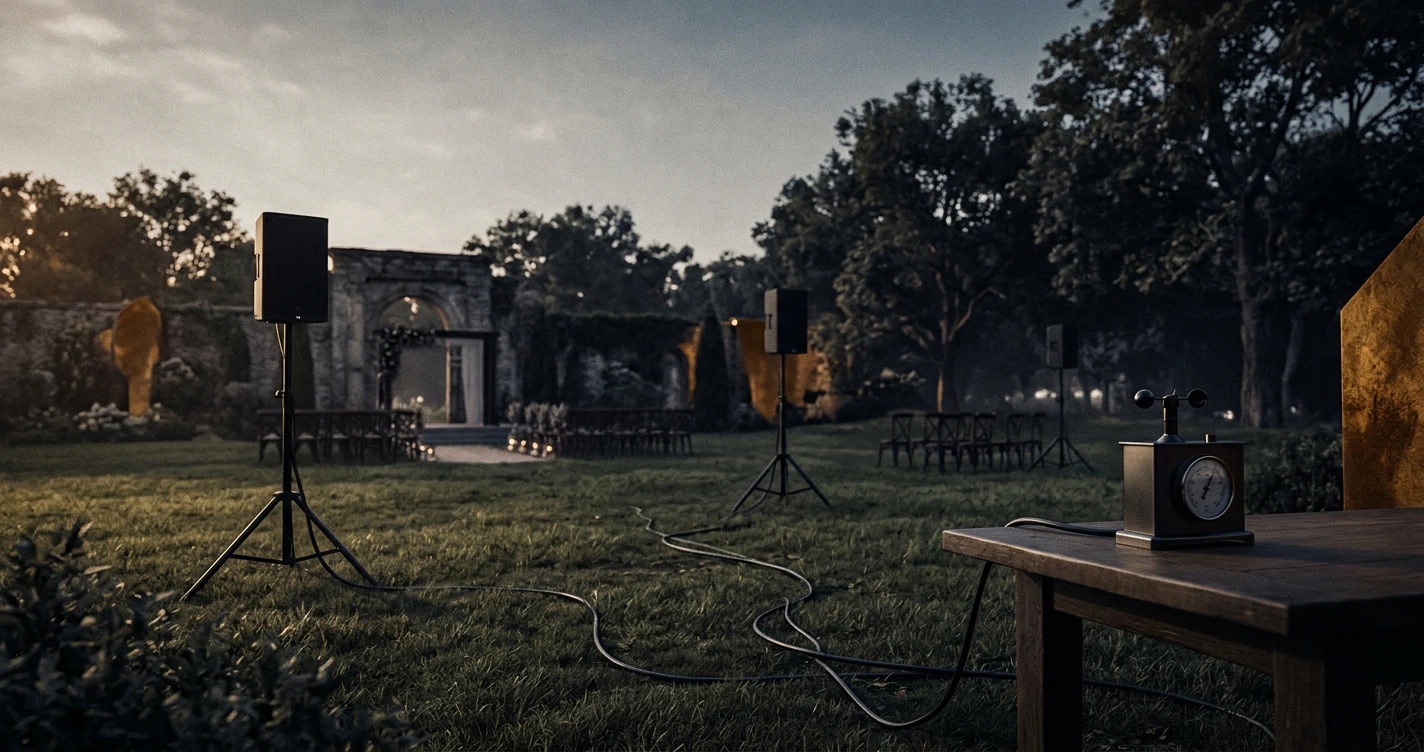
Outdoor Wedding Sound: What You Need to Know
Open-air venues lose sound the moment it leaves the speaker, so the gear that fills a ballroom will sound thin and patchy in a garden. The fix is planning your coverage, power, wind and weather before the day, not louder volume on the night. These outdoor wedding sound tips walk you through what actually changes when you move your celebration under the sky, from the zaffe entrance to the last song after midnight.
Lebanon is built for outdoor weddings. Rooftop terraces over Beirut, mountain gardens in the Metn, beach venues down the coast: the views are the whole point. The catch is that every one of those beautiful spaces fights your audio in its own way. Here is how to get it right.
Why Open-Air Venues Need Their Own Sound Tips
Outdoor sound behaves nothing like indoor sound because there are no walls, ceiling or floor to reflect it back to your guests. Inside, those surfaces recycle audio and help it fill the room. Outside, the sound simply travels out and fades. According to Simon Fraser University's acoustics handbook, a sound level drops roughly 6 dB for every doubling of the distance from the source (Simon Fraser University, accessed 2026). That means a guest twice as far from the speaker hears a noticeably quieter mix.
So the back tables can feel left out of the same song the front row is dancing to. Add open space, ambient noise from traffic or the sea, and the natural pull of wind, and a single pair of speakers at the front will never carry the night. Your entrance music, the officiant's voice, your first dance: all of it needs real coverage, not raw loudness.
Choosing the Right Speakers and Coverage
The goal outdoors is even coverage, where every guest hears a full, clear mix no matter where they sit. One loud stack at the front cannot do that. Instead, sound gets spread across zones so the ceremony, dinner and dance floor each get what they need. Because sound keeps dropping with distance, a distributed setup keeps the far corners inside the party instead of straining to hear it.
A practical outdoor coverage checklist:
- Separate the zones. The ceremony, cocktail area and dance floor each need their own coverage, not one system stretched across all three.
- Add fill speakers. Smaller speakers placed deeper into the crowd keep distant tables in the mix.
- Mind the subwoofers. Low end carries differently outdoors, so bass placement matters for a full dance-floor feel.
- Point speakers at people, not empty space. Aim coverage toward where guests actually sit and dance.
- Protect the vocals. Vows, the toast and the zaffe chants all need clear voice reproduction, separate from the music.
This is where a full production approach helps. With DJ JAY-P OFFICIAL, the sound, lighting and effects are handled as one plan, so the speaker layout and the dance-floor lighting are designed together rather than bolted on. If you want to understand how rental gear and setup pricing work in this market first, our guide to sound and lighting rental in Lebanon is a good starting point.
Dealing With Wind, Power and Acoustics
Wind, power and open acoustics are the three problems that catch outdoor weddings off guard, and all three are solvable with planning. Wind pushes sound off course and roars into microphones. Many outdoor venues lack enough clean power for a full rig. And without walls, the mix needs careful tuning so it stays warm instead of harsh.
Start with wind. Every microphone needs a windscreen, and your officiant does better with a clipped lavalier or headset mic than a handheld one in a breeze. Speakers should work with the prevailing wind, not fight it. A quick sound check at the real ceremony time, when the afternoon breeze actually shows up, catches most surprises.
Power comes next. Gardens, rooftops and beaches rarely have the outlets a wedding rig demands. That often means a quiet generator, proper cabling runs and surge protection, all confirmed with your DJ and venue well before the day. A tripped circuit during your first dance is the kind of memory nobody wants.
Finally, respect the volume limits. The World Health Organization notes that sound levels below 80 dB are unlikely to cause hearing damage, and that at higher levels safe listening time drops fast (World Health Organization, accessed 2026). Many residential and mountain venues set their own noise caps, so a system tuned for clarity rather than sheer force keeps you compliant and keeps your guests comfortable.
Building Backup Plans for Weather and Noise Limits
A backup plan is not optional for an open-air wedding, because weather and venue rules can change your night with no warning. A sudden mountain shower, a gusty evening or a strict cut-off time can all interrupt the celebration. The couples who stay relaxed are the ones whose DJ and planner already agreed on a plan B.
Your outdoor backup checklist:
- Rain cover for the gear. Speakers, mixers and cabling need protection ready to deploy, even on a clear forecast.
- A move-indoors trigger. Decide in advance at what point the party shifts under a tent or indoors, and who makes that call.
- A known noise cut-off. Confirm the venue's latest allowed time so the after-party does not get shut down mid-song.
- Protected power. Surge protection and a backup power source guard against outages.
- A simplified set. A smaller mobile setup can keep music going if the main rig has to move.
Planning this well is the same discipline that makes any event run smoothly. When you are weighing entertainment options overall, make sure these backup details come up in your early vendor conversations. The best time to ask about a weather plan is before you sign, not when clouds roll in.
Lighting an Outdoor Reception After Sunset
Outdoor lighting has to do the job the sun was doing, because an open-air reception goes dark quickly once golden hour ends. Indoors you control the light all night. Outside, you lose your natural light source right around dinner, and without a plan the dance floor turns into a black void. Good lighting replaces that warmth and sets the mood for the rest of the night.
Think in layers. String lights and warm ambient fixtures give the whole space a soft glow. Uplighting along walls, trees or a tent interior adds depth and color that photographs beautifully. Then the dance floor gets its own energy from moving lights and effects. The trick is timing: lighting should build as the sun drops so the shift from day to night feels smooth rather than abrupt.
This is also where outdoor venues shine for special effects. Cold-spark volcanos, dry ice for a floating first dance and fireworks all read dramatically against a dark sky, and open settings give them the clearance they need, with wind direction and venue rules checked first. Handled by one team alongside the sound, the lighting and effects hit exactly on the beat.
Whichever direction you take, plan your sound and your lighting together, not as separate bookings. When you are ready to map out your own outdoor celebration, from the zaffe to the last song, a quick message to DJ JAY-P OFFICIAL over WhatsApp is the easiest way to start shaping how your night will both sound and look.
Frequently asked questions
Do I need more speakers for an outdoor wedding than an indoor one?
Usually yes. Open air has no walls to bounce sound back, so audio escapes instead of filling the space. Most outdoor receptions need distributed speakers covering the ceremony, dinner and dance zones separately rather than one front-facing pair.
How do I deal with wind ruining the sound at an outdoor ceremony?
Use windscreens on every microphone, point speakers with the prevailing wind rather than against it, and keep a lavalier or headset mic ready for the officiant. A short sound check at the real ceremony time helps you catch gusts early.
What about power for an outdoor venue with no outlets nearby?
Plan it before the day. Many gardens, rooftops and beaches lack enough clean power for a full rig, so you may need a quiet generator, heavy-duty cabling and surge protection. Confirm this with your DJ and venue in advance.
When should outdoor reception lighting turn on?
Set lighting to build as the sun drops, not all at once after dark. String lights, uplighting and effect lighting should be tested before guests arrive so the transition from golden hour to night feels smooth and photogenic.
Are special effects like cold-spark volcanos safe outdoors?
Yes, when run by a professional with proper spacing and clearance. Outdoor settings actually suit effects like cold-spark volcanos, dry ice and fireworks well, as long as wind direction, overhead cover and venue rules are checked first.